OpenAI API
The user’s memory behind the OpenAI API or any function-calling model: declare search_memories and add_memory as functions and call the SDK when the model asks.
Everything below assumes MEMBASE_API_KEY in the environment, minted at Read & write
with Your profile ticked (Authentication & Scopes), and your model
provider’s key beside it. The loop is the same in every harness:
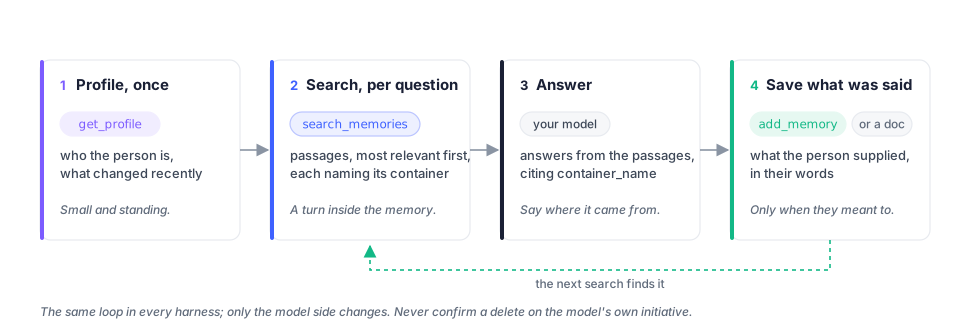
The tool-calling loop
Section titled “The tool-calling loop”Declare the two verbs as functions and call the SDK when the model asks. The shape is the Chat Completions tool-calling loop; any provider with the same loop takes the same two definitions.
import OpenAI from "openai";import { Membase } from "membase-sdk";
const memory = new Membase();const openai = new OpenAI();
const tools: OpenAI.Chat.Completions.ChatCompletionTool[] = [  { type: "function", function: {      name: "search_memories",      description: "Search the user's memory. Use it before answering anything about their past work, decisions or preferences.",      parameters: { type: "object", properties: { q: { type: "string" } }, required: ["q"] } } },  { type: "function", function: {      name: "add_memory",      description: "Save one fact the user asked to remember, in their own words.",      parameters: { type: "object", properties: { content: { type: "string" } }, required: ["content"] } } },];
async function runTool(name: string, args: Record<string, string>): Promise<string> {  if (name === "search_memories") {    const { results } = await memory.search({ q: args.q, limit: 5 });    return JSON.stringify(results.map((h) => ({ memory: h.container_name, content: h.content })));  }  await memory.memories.add({ content: args.content });  return "saved";}
const profile = await memory.profile();const messages: OpenAI.Chat.Completions.ChatCompletionMessageParam[] = [  { role: "system", content: "Standing facts about the user: " + profile.static.join("; ") },  { role: "user", content: "What did we decide about the ledger?" },];
for (;;) {  const turn = await openai.chat.completions.create({ model: process.env.OPENAI_MODEL!, messages, tools });  const reply = turn.choices[0].message;  messages.push(reply);  if (!reply.tool_calls?.length) { console.log(reply.content); break; }  for (const call of reply.tool_calls) {    if (call.type !== "function") continue;          // tool_calls is a union; custom tool calls carry no `function`    const content = await runTool(call.function.name, JSON.parse(call.function.arguments));    messages.push({ role: "tool", tool_call_id: call.id, content });  }}
The same loop in Python is the SDK’s client.search(...) and client.memories.add(...)
behind two function definitions; nothing else changes.
Rules that hold in every shape
Section titled “Rules that hold in every shape”- Profile once, search per question. The profile is small and standing; search is a turn inside the user’s container.
- Cite the container. Every hit names
container_name; say where an answer came from. - Save what the user supplied, in their words, and only when they asked or plainly meant to.
- Never confirm on your own. A delete or forget without
confirm=trueanswers with ahowsentence; relay it and stop. - Treat
403as withdrawn access. The owner narrowed or revoked the key; do not retry with it. - Expect the first search to be slow. Up to a minute after a quiet spell; keep the SDK’s timeout.
The same rules, with the reasons, are on Memory operations.