Memory operations
Every verb of the agent protocol end to end: containers, search, the profile, notes, documents, ask, forget and delete, what a run does to them, and what code sees when the app does something.
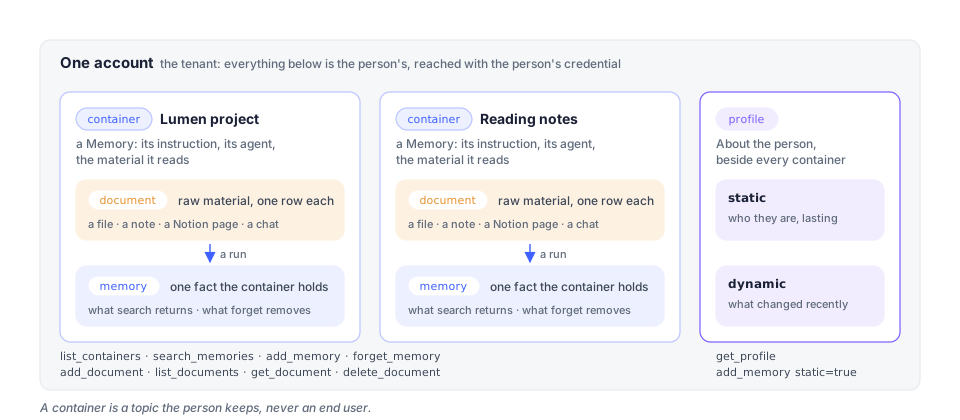
The API has three nouns and a handful of verbs. This page walks them in the order a program meets them, says what each does inside the user’s account, and what code sees when the person, a schedule or the app does something on its side. Every snippet is the Python SDK; the TypeScript and REST shapes are on the SDKs and the API reference.
| Noun | In the app | What it is |
|---|---|---|
| container | a Memory | one named space of memory, with the agent that keeps it and the material it reads |
| memory | an item on a Memory’s page | one fact the container holds, or one fact of the user’s profile |
| document | a row under a Memory’s sources | one piece of raw material a container read: a file, a note, a page |
Containers
Section titled “Containers”containers = client.containers.list()["containers"] # what the key reachesdecisions = next(c for c in containers if c["name"] == "Project decisions")list_containers returns each Memory in the credential’s reach as {id, name, description, …};
the id is the container every other call takes. A Memory outside the reach is not listed
and cannot be told apart from one that does not exist. For a developer key the list follows
the order the Memories were granted in. The assistant’s own memory is not a container: code
meets it as the profile.
What a Memory’s tile says in the app, and what it means to code:
| Tile word | Meaning | In the API |
|---|---|---|
| Empty | no instruction yet | listed, searches answer nothing |
| Add a source | reads nothing yet | listed, list_documents is empty |
| On sale | listed on the Marketplace | buyers hold agent-endpoint credentials to it |
| Subscribed | bought from someone else | ask_agent only; no documents, no writes |
Renaming a Memory changes name and container_name; the id never changes. Deleting a
Memory is the owner’s, in the app, and has no agent-protocol verb.
Search
Section titled “Search”hits = client.search("what did we decide about the ledger", container=decisions["id"], limit=5)for h in hits["results"]: print(h["container_name"], "·", h["content"])Omit container to search every Memory in reach at once; each hit still names its container.
The answer lists passages most relevant first, and containers[] marks any Memory that could
not answer yet.
A search is a turn inside the account’s container, not a query on an index. The first one
after a quiet spell includes runtime startup; the SDKs default to 90
seconds per request, which is configurable and is not a latency guarantee. There are no metadata filters, because there is no server-side index to apply
them to: put what matters in the content. Search is retrieval; ask is an answer.
A Memory with no learned content may return no results. An explicitly requested container
outside the key’s reach is refused with 403; an untargeted search omits it. Check
containers[].error before interpreting an empty result: an unavailable model is a failed
search, not evidence that no matching memory exists. That field holds only a Memory that
could not run a turn (no model, dormant, no agent container); any other failure inside one
Memory fails the whole request. Search never answers 429.
The profile
Section titled “The profile”p = client.profile(q="working hours")p["static"], p["dynamic"], p["results"]The profile sits beside the containers: the standing facts the assistant keeps about the
person (static: who they are, lasting preferences) and the most recently changed ones
(dynamic). get_profile reads it, and only on a credential whose owner ticked the profile;
without the tick the operation is not offered at all. Read it once, near the start of a
conversation. Code writes to it with add_memory and static=True.
Add a memory
Section titled “Add a memory”client.memories.add("We settled on Postgres for the ledger.", container=decisions["id"]) # a note it readsclient.memories.add("The user prefers dark mode.", static=True) # a standing fact → the profileA note is raw material, and this call attempts to start its learning run asynchronously: it
answers with memory_id, document_id, status: "queued" and learning_run. Use the
document_id and the same polling as a document write; acceptance is not completion. A
standing fact about the person (static=True) goes to the profile instead of any Memory,
and is recorded synchronously: the answer is {"static": true, "status": "recorded", "run_id", "content"}, with no document and nothing to poll. Over REST POST /v1/memories
answers 202 either way. With exactly one Memory in reach container may be omitted; with
several it is required. Needs a Read & write key.
Add a document
Section titled “Add a document”doc = client.add("…the text…", container="mv-…", title="Call with Acme", custom_id="call-2026-09-24", metadata={"source": "crm"})doc["status"] # "queued"doc["document_id"] # poll documents.get(id)["learned"]The text (or a public url to fetch, one or the other) lands in the Memory’s upload folder in
the account’s Files, is connected as a source on the spot, and a learning turn starts on its
own; the call answers 202. The same custom_id again answers status: "exists" with the
document’s id, container and path and starts nothing, so retries are safe.
metadata is kept for your bookkeeping; search does not filter on it. document_id can be
null on the 202 when the folder sync had not written the row yet; list the container’s
documents a moment later. Uploads are capped at 32 MiB per file, on every plan.
What the 202 becomes
Section titled “What the 202 becomes”When a learning run starts, it appears on the account’s Activity page. After a successful
run over that material, the document’s learned is true and search can retrieve what it
learned. A 202 alone does not guarantee that a run started: it can be deferred while the
agent is paused or capacity is unavailable. Inspect learning_run and the Memory’s Report. If it ends in Run failed,
the document is still listed and still unread, and the run’s report says why; usually the
account has no working model under AI Setup, or a source needs reauthorization.
Documents
Section titled “Documents”docs = client.documents.list(container="mv-…")["documents"] # newest firstfor d in docs: detail = client.documents.get(d["id"]) print(d["id"], d.get("title"), "learned" if detail.get("learned") else "unread")
client.documents.get("srcitem_…")client.documents.delete("srcitem_…", confirm=True) # Full accessA document is one piece of raw material a Memory has read or will read: a file in a folder
source, an uploaded file, a Notion page, a conversation the browser extension captured, or
what add_document handed in. learned is false until a run has committed it; it is the flag
to poll after add_document. It is computed per source, not per document: true when the
Memory’s last successful run is at or after the source’s current version. So when a new file
lands in the same upload folder, every document in that folder reads learned: false again
until the next run.
Sync and run are two different things
Section titled “Sync and run are two different things”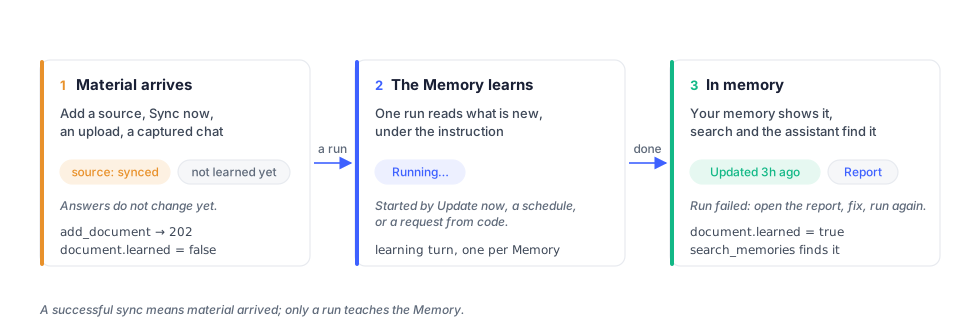
A sync fetches raw material and stops. It runs no model, reads nothing into memory and
never changes what a search answers. A run (the learning turn) is what reads the unread
material. In the app the Memory’s button says Update now while a source holds material
it has not read; a schedule does the same on a cadence; add_document starts a run itself.
“Unread” is decided by versions, not clocks: a sync that changed nothing, or a run on another
Memory, cannot make this one look up to date.
add_document normally starts learning without a schedule; if it is deferred, use the
Memory’s next run after fixing the cause. A schedule
matters for material that arrives without a call: a folder the person keeps adding to, a
Notion selection that changes. When a schedule fires, nothing changes in the API except the
memory itself: learned turns true and the next search answers from what the run learned.
There is no agent-protocol verb to create or pause a schedule; it is the owner’s, in the app.
answer = client.ask("Summarise what the seller learned about Postgres RLS.")ask_agent is the other kind of read next to search: an agent’s answer from what its Memory
learned. It answers only on a credential that exposes an agent, a marketplace
subscription or a share the owner made; an ordinary developer key holds no agent, and the
call is refused with 403 · unauthorized · tool 'agent_invoke' is not in this agent's capability profile. The buyer gets answers, never files. A product that wants to put a model
over the person’s memory uses search and its own model (Claude API,
OpenAI API); a product that wants a Memory’s own agent to answer subscribes
to it.
workflow_invoke belongs to workflow exposures, a canvas run as an endpoint, and is offered
only over MCP on a credential that exposes one.
Forget and delete
Section titled “Forget and delete”client.memories.forget("12", container=decisions["id"], confirm=True)client.documents.delete("srcitem_…", confirm=True)Both need a Full access key, and even then they do not run on a bare call: without
confirm=true the answer is 200 with status: confirmation_required and a how sentence
to relay to the person. Pass confirm=true only after they agreed; from a developer key that
counts as the owner’s confirmation. A consent-minted client is never offered these verbs at
all: from an AI app the call is refused with 403 · unauthorized · tool 'delete_document' is not in this agent's capability profile, not answered with the sentence. What is
forgotten or deleted is gone from the next search; nothing on the platform caches it.
Deleting a Memory, a source’s imported material or the account has no agent-protocol verb; those are the owner’s, in the app.
client.rules()memory_rules returns the user’s standing rules for this credential: what the skill tells an
AI about behaving beneath the ceiling the server enforces.
What code sees when the app does something
Section titled “What code sees when the app does something”| The person | Code sees |
|---|---|
| selects Update now, or a schedule fires | documents’ learned turns true; the next search answers from the run |
| switches a Memory off for the key under Use in | 403 · may not use that container on the very next call, same token |
| lowers the key’s access | 403 · not in this agent's capability profile on the verbs above it |
| revokes the key, or it expires | 403 · unauthorized on every call; mint another |
| removes a source | its documents stop being listed; what was learned stays until the Memory is deleted |
| deletes the Memory | it is no longer listed; searches no longer answer from it |
| has no working model for its agent | a failed turn, surfaced as 422 · capability_unavailable or a search entry in containers[].error; stored memory remains, documents may wait unread. Read code on a 422: validation there is a malformed body, not a model problem |
| is on the free plan with its free turns spent | 422 · reason: dormant until they bring a model or move to a paid plan |
| already has two agent turns running, or a token exceeds its per-minute request limit | 429 · rate_limited on add_memory with static, forget_memory and ask_agent (search never raises it; add_document never does, its learning is deferred with learning_run null); no Retry-After is sent; the SDK backs off and retries twice |
Rules of the road
Section titled “Rules of the road”- Profile once, search per question. The profile is small and standing; search is a turn inside the user’s container.
- Cite the container. Every hit names
container_name; say where an answer came from. - Save what the user supplied, in their words, and only when they asked or plainly meant to.
- Never confirm on your own. A delete or forget without
confirm=trueanswers with ahowsentence; relay it and stop. - Treat
403as withdrawn access. The owner narrowed or revoked the key; do not retry with it. - Allow for cold starts. Configure a suitable timeout and inspect per-Memory errors; see API troubleshooting.
- Do not store to filter later. There are no server-side metadata filters; use
custom_idandmetadatafor your own bookkeeping. - The token stays out of logs. Log the key’s hint (
mbk_7f3a92d1…), never the token.